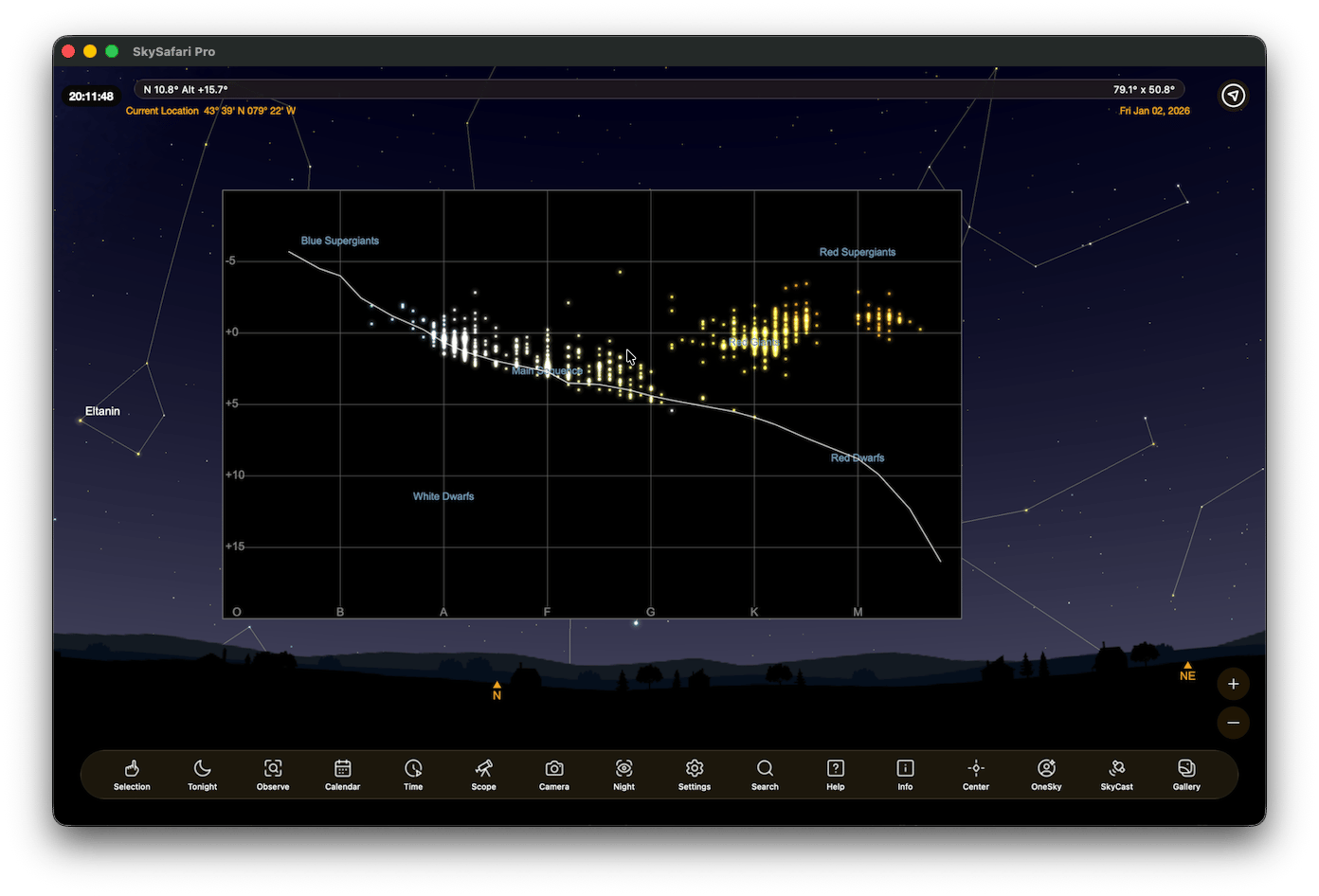
Please Note: This feature is only available in SkySafari Plus and SkySafari Pro.The Hertzsprung-Russell Diagram (H-R Diagram) is a special kind of graph that tells us about a star’s age and its mass. Each dot on the diagram represents a star. The diagram plots absolute magnitude on the vertical axis versus star spectral class on the horizontal axis by default. Young stars that are still burning hydrogen in their cores are found in the “Main Sequence”, the curve along the left side of the graph. The larger and heavier a star is, the farther it will be to the upper left along this curve. Older stars in the “red giant” phase of their lives are no longer on the main sequence, and will be found in the upper right corner of the H-R diagram. Finally, “white dwarf” stars will be found along the bottom left of the H-R diagram, beneath the main sequence.The stars plotted in the H-R diagram are the same stars shown onscreen in the sky chart. You can tap on any star in the H-R diagram, and SkySafari will draw a marker around this star, allowing you to identify it. This makes it easy to identify stellar oddballs, such as white dwarfs, supergiants, and extremely massive main sequence stars. Conversely, you can tap any star in the sky chart, and SkySafari will highlight this star’s position (with a marker) on the H-R diagram.Tip: The H-R diagram is fully dynamic. If you scroll around the screen or change your field of view, the stars shown onscreen will change, and the H-R diagram will update to plot these new stars.
The H-R Diagram can be moved around the sky chart by touching the middle and dragging it to a new location. It can also be resized by dragging on the corners or edges.
VisibilityShow H-R Diagram: Toggles the H-R Diagram on/off in the sky chart.Show Region Labels: Labels the areas of red giants, white dwarfs, and main sequence stars.Show Main Sequence: Draws a line representing stars on the main sequence. Any star that appears close to this line is probably a main sequence star (a star that is still burning hydrogen fuel).Show Grid Lines: Draws gridlines from the vertical and horizontal axes.
Color: Uses a star’s B-V color as the field along the horizontal axis. Hotter stars have a lower B-V value.Temperature: Plots star temperature (in thousands of degrees Kelvin) along the horizontal axis. Degrees Kelvin are equal to degrees Celsius + 273.Spectrum: Plots star spectral class along the horizontal axis. There are seven main types of stars. In order of decreasing temperature, O, B, A, F, G, K, and M. The Sun is a G type star (specifically G2V), a yellow dwarf and a main sequence star.
Absolute Magnitude: Absolute magnitude tells us how bright objects would appear if they were all at the same distance (the distance we use is arbitrary, but has been chosen to be 10 parsecs). As with visual magnitude, a lower absolute magnitude means a brighter body.Visual Magnitude: Tells us the brightness of a star in the sky as seen by an observer on Earth. The brighter an object appears, the lower its magnitude value. The Sun, at visual magnitude of −26.7, is the brightest object in the sky.Luminosity: Amount of light and energy emitted by a star.Note: White dwarfs are very dim and few are in SkySafari’s star catalogs (the Hipparcos/ Tycho catalogs), so few will be found in SkySafari’s H-R diagram.