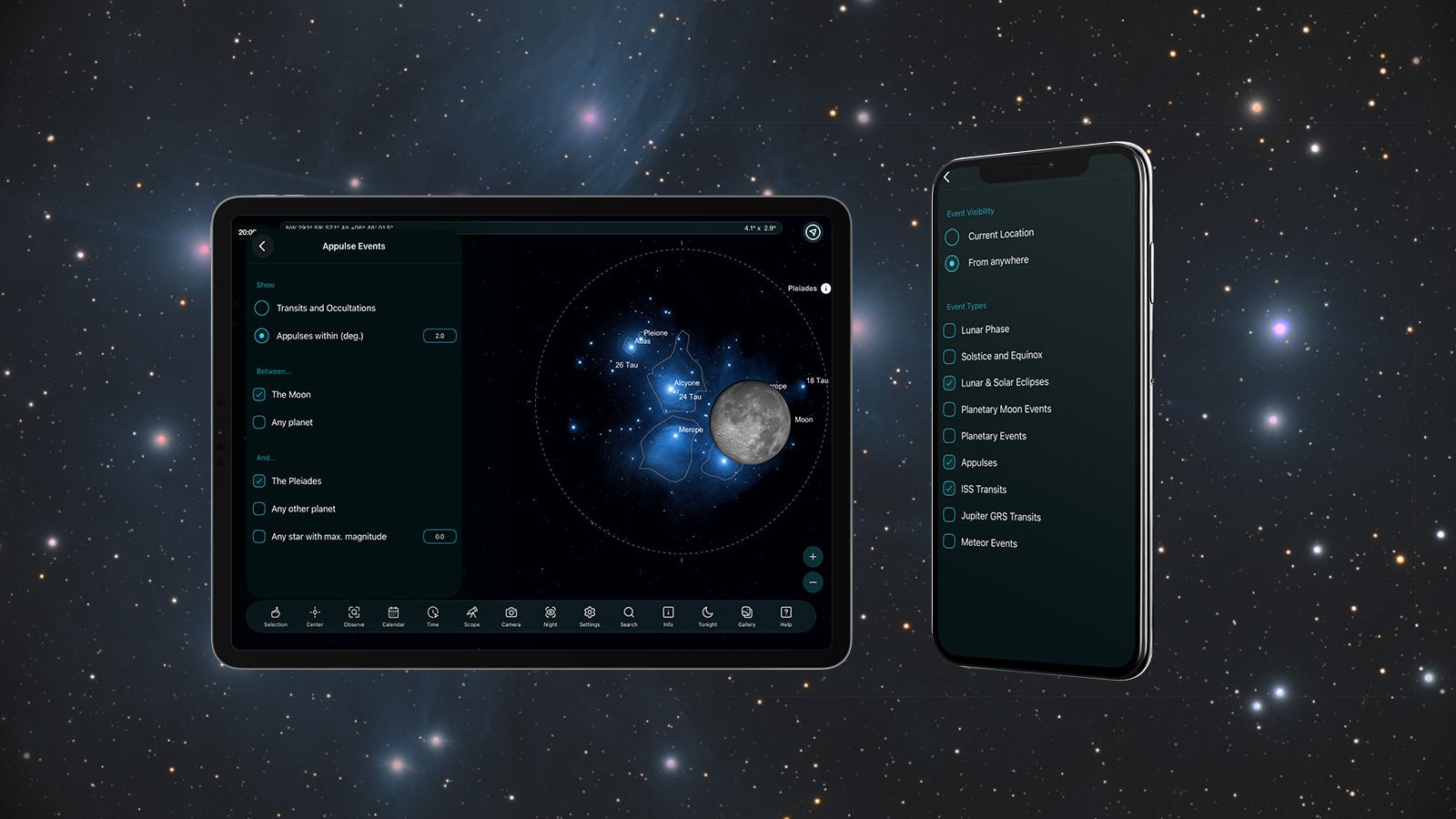
Events HelpThe Event Finder is a powerful search engine that finds astronomical events visible tonight and far into the future. The finder dynamically generates a listing of moon phases, eclipses, Jupiter satellite events, meteor showers and planetary phenomenon such as conjunctions, elongations and oppositions to name but a few of the events that can be displayed.You open the Event Finder by tapping Observe in the Toolbar and selecting Events.Events by Date: By default, the list of events is created for a week in advance from today’s date. Tap Start Date and End Date to search for astronomical events on a specific date range. After setting your dates, SkySafari dynamically updates and generates a list of events.Note: Creating a list of events for a long date range requires a greater amount of time to calculate. For faster searches limit the date range to a few months. Knowing what specific objects you are interested in will also speed up searches.Viewing Events: Tap on an event in the list of generated events to simulate the event in SkySafari.
Current Location is selected by default and displays only those events that are visible from your current location.Visible From anywhere lists all events, including those not visible from your current location.Tonight lists events visible from your current location and suppresses events that are only visible during daylight.
The event type options allow you to select what type of astronomical events to search for and display.Most of the listed Event Types have special options associated with them. Taping on an event type name will display the options for that event type. For example, selecting “Lunar Phase” will display options for selecting the type of lunar phases to include in your search.Some of the event types might not be familiar to you:Lunar Phase Events: New Moon is the Moon as it appears on Earth when it is positioned between Earth and the Sun at the beginning of a cycle of lunar phases. The new moon rises and sets with the Sun.During First Quarter Moon and Last Quarter Moon half of the Moon’s disc is illuminated.Full Moon is the Moon’s appearance from Earth when it is positioned directly opposite the Sun. The Moon is full two weeks after new moon. The full moon rises at sunset and sets at sunrise when Earth is between the Moon and the Sun.Lunar and Solar Eclipse Events: A Total Lunar Eclipse is an eclipse of the Moon where Earth crosses between the Sun and Moon, blocking sunlight from reaching any of the Moon’s surface. During a total eclipse, the Moon darkens slightly and takes on a reddish colour.A Partial Lunar Eclipse is an eclipse of the Moon where Earth crosses between the Sun and Moon, blocking sunlight from reaching only part of the Moon’s surface. This part will appear darker than the rest of the Moon.A Penumbral Solar Eclipse is an eclipse of the Moon where Earth crosses between the Sun and Moon, but only partially blocks the Sun’s light. Because some light still reaches all parts of the Moon, the Moon does not darken noticeably during a penumbral eclipse.A Partial Solar Eclipse is an eclipse of the Sun where the Moon covers only part of noticeably during a partial eclipse.A Total Solar Eclipse is an eclipse of the Sun where the Moon completely covers the Sun.An Annular Solar Eclipse is an eclipse of the Sun where the Moon passes directly in front of the Sun, but does not completely cover it. At the eclipse’s peak, a ring of sunlight still shines around the Moon’s edges.A Hybrid Solar Eclipse is an eclipse that starts as an annular solar eclipse, then becomes a total solar eclipse and at the end returns to an annular solar eclipse. The total eclipse phase of a hybrid eclipse tends to be short in duration.Planetary Moon Events: A Shadow Transit is the passage of a moon’s shadow across the face of its parent planet.Shadow transits are a favourite event among planetary observers.A Transit is the passage of a moon over the face of its parent planet.An Occultation is the disappearance—eclipse—of one moon behind its parent planet.An Eclipse occurs when a moon passes through the shadow of its parent planet.Planetary Events: A Solar Transit is the passage of one planet across the face of the Sun. These rare events require the use of a safe solar filter designed specifically for viewing the Sun.Greatest Elongation is the greatest angular distance to the east or west of the Sun reached by a planet, usually Mercury and Venus. When a planet is at its eastern elongation, it sets after the Sun and is at its best visibility in the evening sky. When a planet is at its western elongation, it sets before the Sun and is at its best visibility in the morning sky.There are two types of Solar Conjunctions. An Inferior Conjunction is the passage of Mercury or Venus between Earth and the Sun. The outer planets cannot pass between Earth and the Sun and therefore cannot come to inferior conjunction. A Superior Conjunction is the position of a planet when it is on the far side of the Sun (and in conjunction with the Sun).A Quadrature occurs when the angle between the Sun and a planet is 90 degrees or a quarter of a circle. Eastern Quadrature is defined when a the planet is 90 degrees to the east of the Sun, and Western Quadrature when a planet is 90 degrees to the west of the Sun.Solar Opposition is the position of a planet when it is opposite the Sun in the sky.Appulses: An appulse is the close apparent approach of one celestial object to another in the sky. Use this option to find the precise moments when the Moon or planets pass near the Pleiades, other planets, or stars of a selected magnitude. This feature also includes transit and occultation search capabilities.ISS Transits: Find the precise moments when the International Space Station passes in front of the Sun or Moon as seen from your location. This option calculates upcoming solar and lunar transits of the ISS and provides timing and visibility details for each event.Jupiter GRS Transits: Predict transits of Jupiter’s Great Red Spot (GRS). A transit occurs when the GRS crosses Jupiter’s meridian (the centerline of the planet). If the timings are off, you can adjust the GRS longitude value in Settings > Solar System > Jupiter GRS Longitude.Meteor Shower Events: When the Earth’s orbit crosses the path of debris left behind by a comet, there is a meteor shower as the dust particles burn up in Earth’s atmosphere. Only the major meteor showers that average more than 10 meteors per hour are displayed.