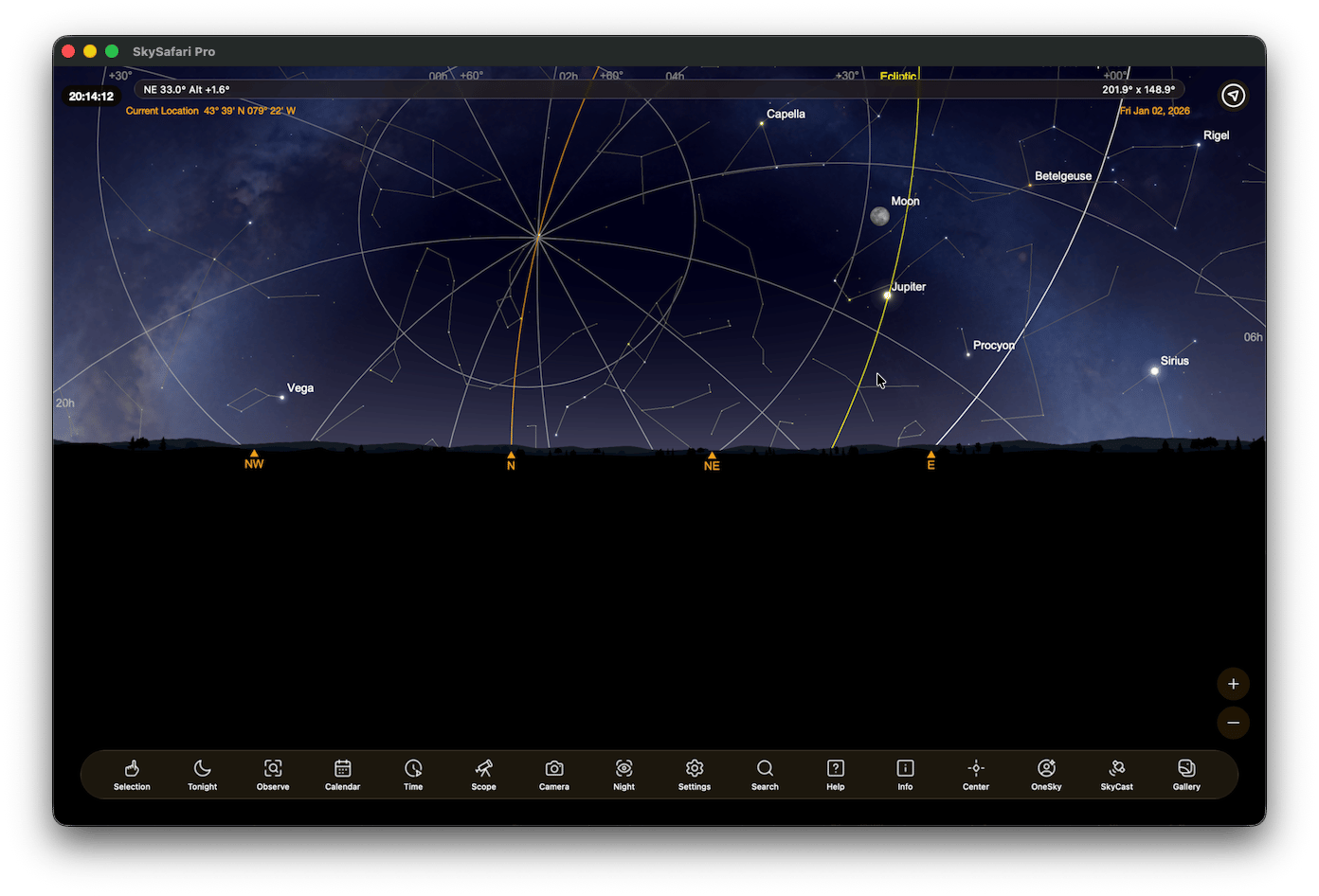
The settings in this view let you show or hide grids which display the major celestial coordinate systems, as well as the reference lines and points that those systems are based on.
Show Grid: Sets whether a celestial coordinate grid is displayed on the sky chart. When turned on, the following items are enabled:with Horizon Coordinates: displays an alt-azimuth coordinate grid on the sky chart.with Equatorial Coordinates: displays a right ascension/declination grid on the sky chart.with Ecliptic Coordinates: displays an ecliptic longitude/latitude grid on the sky chart.with Galactic Coordinates: displays a galactic longitude/latitude grid on the sky chart.Please Note: Ecliptic and Galactic coordinate grids are only available in SkySafari Pro.
Celestial Equator: Sets whether the celestial equator is displayed on the sky chart. The celestial equator is the plane of the Earth’s equator projected onto the celestial sphere.Galactic Equator: Sets whether the galactic equator is displayed on the sky chart. The galactic equator is the plane of the Milky Way galaxy projected onto the celestial sphere.Ecliptic Path: Sets whether the Ecliptic path is displayed on the sky chart. The Ecliptic is the plane of the Earth’s orbit projected onto the sky. It is also the annual path of the Sun around the celestial sphere.Meridian Line: Sets whether the meridian is displayed on the sky chart. The meridian is the projection of your longitude on Earth onto the celestial sphere. It extends from the northern horizon through the zenith to the south cardinal point on the horizon. An object is said to transit when it crosses the meridian.
Celestial Equator Ticks: Adds bars markers at every 10 minutes of arc and labels at each hour of arc on the celestial equator line.Ecliptic Ticks: Adds date bar markers and labels along the ecliptic line.Meridian Ticks: Adds bar markers at 1 degree intervals and labels every 10 degrees on the local meridian line.
Celestial Poles: Sets whether the celestial poles are displayed on the sky chart. The celestial poles are where the Earth’s polar axis (i.e. the line perpendicular to the plane of the Earth’s equator) intersects the celestial sphere. The north and south celestial poles are currently in the constellations Ursa Minor and Octans, but they move slowly over the centuries due to precession.Galactic Poles: Sets whether the galactic poles are displayed on the sky chart. The north and south galactic poles are where a line perpendicular to the plane of the Milky Way galaxy intersects the celestial sphere. They are currently located in the constellations Coma Berenices and Sculptor, respectively.Ecliptic Poles: Sets whether the ecliptic poles are displayed on the sky chart. The ecliptic poles are where a line perpendicular to plane of the Ecliptic intersects the celestial sphere. The north and south ecliptic poles are in the constellations of Draco and Dorado, respectively.Zenith & Nadir: Sets whether the zenith and nadir are displayed on the sky chart. This marks and labels the points directly overhead and underneath your feet.Equinox Markers: Displays markers for the Vernal and Autumnal Equinoxes. The Vernal Equinox is the sun’s position relative to the stars on the first day of spring (in the Northern Hemisphere), while the Autumnal Equinox is the sun’s position relative to the stars on the first day of fall. More precisely, they are the sun’s positions in the sky at the two exact times when the plane of Earth’s equator is the same as the plane defined by Earth’s revolution around the sun.Solstice Markers: Displays markers for the Summer and Winter Solstices. The Summer Solstice is the sun’s position relative to the stars on the first day of summer (in the Northern Hemisphere), while the Winter Solstice is the sun’s position relative to the stars on the first day of winter. More precisely, they are the sun’s positions in the sky at the two exact times when the plane of Earth’s equator is inclined at the largest angle (about 23.5 degrees) to the plane determined by Earth’s revolution around the sun.